[01] Context
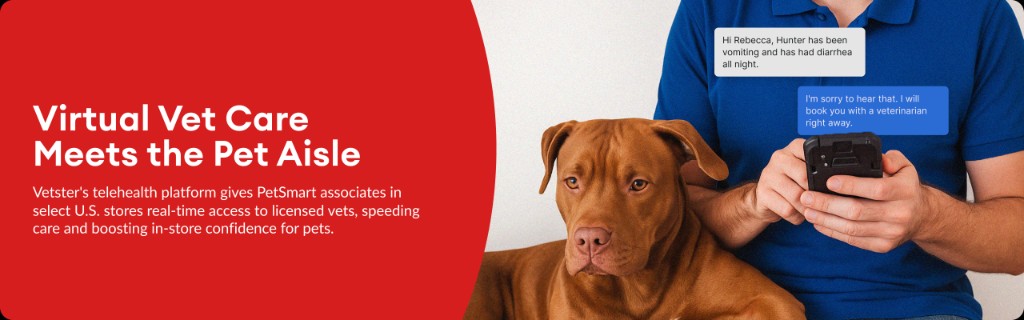
What is in the store, and why there was no fast path to a vet. PetSmart spans two associate responsibilities: pets for sale on the retail floor, and pets in active care. When health issues show up in either group, staff need licensed veterinary guidance on the spot, without leaving the floor or arranging risky off-site transport.
WHERE_PETS_ARE_IN_CARE
Associates watch animals in four settings, across species from dogs and cats to reptiles, birds and small mammals.
[02] Problem
PetSmart associates needed faster, safer access to veterinary support for animals in their care, without pulling teams off the floor for long off-site trips.
RISKY_TRANSPORT
Associates used personal vehicles to move sick or injured pets to clinics, creating liability exposure and animal risk during transit.
SLOW_TIME_TO_CARE
Getting to an in-person visit could take hours, a critical delay when an animal shows distress on the floor or in PetsHotel.
OPERATIONAL_COST
Each off-site trip meant downtime, mileage, and disruption, multiplied across 1,633 locations.
INCONSISTENT_VET_ACCESS
Only about 50 to 64% of stores have an in-store clinic, and those have limited hours and limited vets. In the rest, no fast path at all.
So associates drove sick animals to an outside clinic in their own cars. Hours of delay, real risk in transit, and liability for the store, every time.
[03] Business impact
A pilot has to earn the rollout.
1,633
POTENTIAL_REACH
US stores the program can expand into if the pilot proves itself.
WHAT_I_DESIGNED_AGAINST
Completed consults, because that is the only event that pays and the only proof PetSmart expands on.
Every drop off before the consult finishes costs twice: the revenue on that visit, and the evidence the partnership is built on.
WHAT_EACH_SIDE_NEEDED
Two parties, two sets of needs, and one flow that had to satisfy both.
PETSMART
Lower vet costs, less lost time
Cheaper vet care for in-store animals, and less staff time lost driving to off-site appointments.
VETSTER
Completed medical appointments
Revenue lands only on a completed consult, so volume and conversion both had to hold.
MY_GOAL
- Give store associates a fast, trusted path to a licensed vet
- Carry every intake through to a completed consult
- Prove the partnership is worth expanding
[04] Constraints
Three things I had to design inside.
CONSTRAINT_01
A non-clinical frontline user
A store employee, not a medical professional.
CONSTRAINT_02
Many settings, many species
Two groups of animals, four settings, and species from dogs and cats to reptiles and birds.
CONSTRAINT_03
Banfield gets first refusal
The in-store clinic has to be checked before a Vetster visit.
[05] Solutions
The full associate path: Get Care, then guided intake that educates store staff on which cases fit telehealth. An RVT concierge starts the consult, gathers symptoms and context for the veterinarian, and hands off to a video visit. Everything rolls up into a care plan and prescription flow at the end.
SCOPE_OF_CARE
Designed for non-emergency cases associates see on the floor, aligned with how PetSmart and Vetster described the public launch:
- Vomiting, diarrhea, infections, allergies, skin concerns, and minor injuries
- Dogs, cats, birds, reptiles, amphibians, small animals
SOLUTION_PATH
-
01
Get Care
Start visit from the store device
-
02
Guided intake
Setting, species, and plain-language questions
-
03
Eligibility check
Telehealth fit, or escalate to in-person
-
04
RVT concierge
Registered tech gathers context and books the vet
-
05
Consult timeline
Video visit, care plan, and Rx if needed
USER_FLOW
Four decisions do the work. Each one either routes the case forward or takes it off telehealth before an associate invests more time.
- Pet’s setting? Salon, PetsHotel and day camp take one intake; sales floor and new arrivals take another.
- Species? Routes into species-specific questions, since a reptile and a puppy do not screen the same way.
- Telehealth eligible? Eligible cases go to the RVT concierge; a critical sign escalates straight to in-person care.
- Vet consult needed? The RVT handles what it can and issues a care plan; anything else goes to a video consult, then Rx transfer if needed.
INTERACTIVE_PROTOTYPE
The associate path, end to end. Tap through guided intake, the RVT concierge, the video consult, and care plan delivery.
[06] Process
From in-store research to a scoped design, aligned and ready to pilot.
01
Discovery & synthesis
I gathered information with PetSmart leadership and store associates, including the PDF guidebook they were working from, then turned it into the pain points worth solving and the rules I had to design inside.
02
Flow, scope & design
With the PM and engineering, I defined the associate path and scoped v1, then designed the guided intake, RVT concierge, consult, and care plan.
03
Prototype testing & handoff
I tested the interactive prototype with PetSmart’s operations team and store associates, engineering and PetSmart IT handled security and compliance, then a final review with leadership and the business owners before handing off to development.
[07] Outcomes
Under real store load, associates kept moving step to step. Conversion and satisfaction held up across the funnel.
EXPERIENCE_PROOF
Intake conversion
85.9%
Concierge conversion
99.6%
Appt completion
95.3%
Associate satisfaction
4.92/5
What those numbers mean on the floor:
- Associates could run intake unaided. Plain-language triage required no veterinary training of the person using it, and an average intake took 0.7 minutes.
- The concierge held the handoff. Associates who finished intake reached the vet, instead of dropping out during the wait.
IT_SCALED_PAST_THE_PILOT
4,200
Completed medical appointments. The program expanded to every telehealth eligible state in the US, and has since launched in Canada.